Tom Lionne
SEO and AI
5 min read
How to rank in Google AI Overviews (formerly Search Generative Experience)
How to rank in AI Overviews: the four levers that really count, the citation figures behind them, a quick self-assessment, and how to track your visibility month after month.
Getting into an AI Overview takes four things: a page that answers the question in a few self-contained sentences, verifiable and dated information, clean markup, and an entity the machine can identify. Organic ranking still helps, but far less than it did a year ago. AI Overviews have been live in the United States since May 2024, and France only got them on 22 July 2026, which means the figures in circulation come from the earliest markets and age quickly.
What are Google AI Overviews, and where are they live?
A generated answer above the results
An AI Overview is a block of text written by a model, shown at the top of the results page, with a few links to the sources it used. The feature was first called Search Generative Experience, or SGE, while it was an experiment in Search Labs. The difference with a featured snippet is fundamental: the snippet copied a sentence from your page, whereas the overview writes a new one from several sources, and you become just one cited reference among others.
From the US launch to the French rollout of 22 July 2026
The United States got AI Overviews first, in May 2024, before a gradual expansion to other countries. France waited a long time, for a reason that is not technical: the question of neighbouring rights with press publishers. Once an agreement was reached, the rollout took place on 22 July 2026, with AI Mode straight after. The practical consequence: the American studies published in 2025 describe a market that is twelve to eighteen months ahead of later ones. The trends they describe are probably right; the percentages cannot be carried over as they are from one market to another.
How to rank in AI Overviews: the four levers
Ranking well helps, but less and less
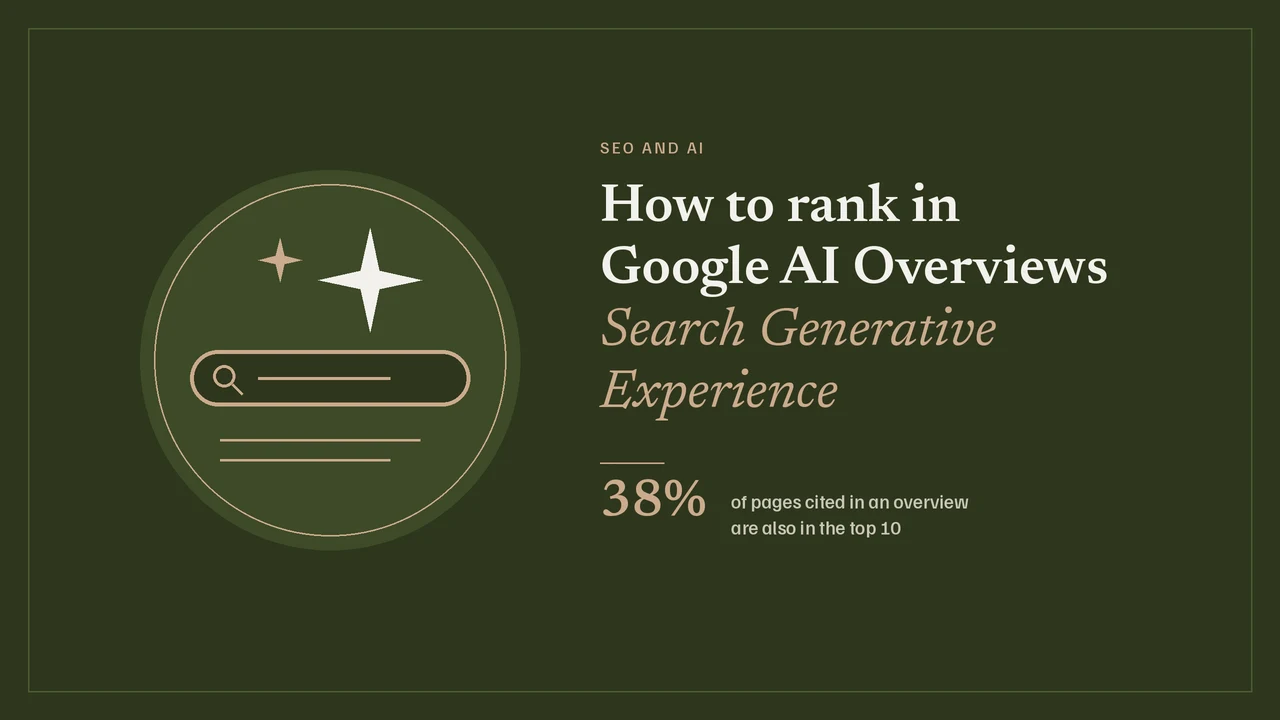
A year ago this was the number one piece of advice: be in the top 10 and the rest will follow. It has aged. Ahrefs’ analysis of 863,000 queries and 4 million citations shows that only 38% of the pages cited in an overview also appear in the classic top 10 for the same query, compared with 76% a year earlier. In other words, the model reaches further and further into the index. A good ranking is still an asset, but no longer a requirement, and that opens a door for sites that are not fighting on equal terms on competitive queries.
Answer in forty to sixty words right after the heading
This is the most concrete lever, and the only one you fully control. After each section heading phrased as a question, write the answer in three or four sentences that stand on their own, with no « as mentioned above » and no reference to an earlier paragraph. A model extracts in blocks: a self-contained passage gets reused, a passage that depends on its context gets left aside. Then expand as much as necessary; the detail is there for the human reader.
Add schema markup for AI Overviews
The exact code to copy for each schema type (Article, FAQPage, Product, HowTo, Organization) is covered in detail in the complete JSON-LD implementation guide.
Structured data guarantees no citation, and nobody serious will claim otherwise. It does something else: it removes ambiguity. Correct Article markup says who wrote the text, when, and when it was updated. FAQPage markup explicitly connects questions to their answers. Organization markup with its sameAs links ties the site to a stable entity rather than an isolated domain name. On a site with no markup, it is one of the rare jobs that takes half a day and serves both classic search engines and generated answers. The site’s schema markup generator produces ready-to-paste blocks.
AI crawlers still need to be able to read your pages. Many of them do not execute JavaScript: on a site built with a page builder, or a shop that loads its product pages after the fact, part of the content escapes them. Platforms such as Alli AI serve these crawlers a pre-rendered version of each page and deploy markup across the whole site without touching the code: I cover them in my Alli AI review.
Build a recognisable entity
A model is more willing to cite a source it can attribute to someone. An about page that says who you are, consistent mentions elsewhere on the web, identical business information everywhere, named authors with what they actually do: nothing spectacular, but it is the difference between an anonymous site and an identifiable source.
Are you ready to be cited? An eight-question self-assessment
Before investing, it is worth knowing where you stand. Answer honestly; the score and priorities appear below.
Are you in a position to be cited?
Eight questions, answered yes or no. The score and the three priorities appear below.
How to track AI Overview visibility: tools and the manual method
Rank tracking platforms have added dedicated modules, and specialist tools have appeared. They are useful if you track hundreds of queries. Below that, the manual method is enough and costs nothing: list your twenty customer questions, ask them once a month, and note whether an overview appears, who is cited, and whether you are. A four-column spreadsheet does the job.
Two precautions matter more than the tool. Always run the check under the same conditions, because the answer varies with the wording, the time and the session. And note who is cited instead of you: it is often the most actionable information, because it tells you which format the model prefers on your topic.
Do not track a position, track a frequency. Across twenty questions asked every month, what counts is the number of times you are cited, not the rank of a link in an answer that has no ranks.
To automate this tracking, some tools query ChatGPT, Claude and Gemini every day and show you whether your brand is cited. BabyLoveGrowth is one of them, and it also publishes your articles and finds you links: I go through it in my BabyLoveGrowth review.
What AI Overviews cost in traffic, with figures
Let us be frank: visibility in an overview does not make up for the drop in clicks it causes. Pew Research Center found that 8% of users click on a result when an AI summary is shown, compared with 15% without one. Ahrefs, for its part, reports a drop of around a third in first-position click-through rate on the queries affected. These measurements come from markets that had already been exposed for a year, but the direction is not in doubt.
The strategic consequence is simple. On purely informational queries, part of the traffic will not come back, and it is better to accept that than to rewrite the same pages ten times. The effort shifts to queries where the generated answer is not enough: comparing, choosing, buying, getting in touch with someone. It is also the approach I take in my GEO consulting work.
AI Overview mistakes to avoid
- Applying percentages from 2025 studies as they are to a market that got AI Overviews later and has its own sources.
- Stuffing a page with artificial questions and answers in the hope of triggering a citation: sloppy Q&A blocks have been filtered out for a long time.
- Blocking AI crawlers without thinking it through, then being surprised never to be cited.
- Measuring in positions: in a generated answer there is no rank, only presence or absence.
- Abandoning classic SEO: overviews rely on an index, and that index is still the search engine’s.