Tom Lionne
Technical SEO
5 min read
Semantic cocoon: Laurent Bourrelly’s SEO silo method explained simply
The semantic cocoon explained: Laurent Bourrelly's official definition, how to build one step by step, how it differs from a topic cluster or silo, and the mistakes that cancel it out.
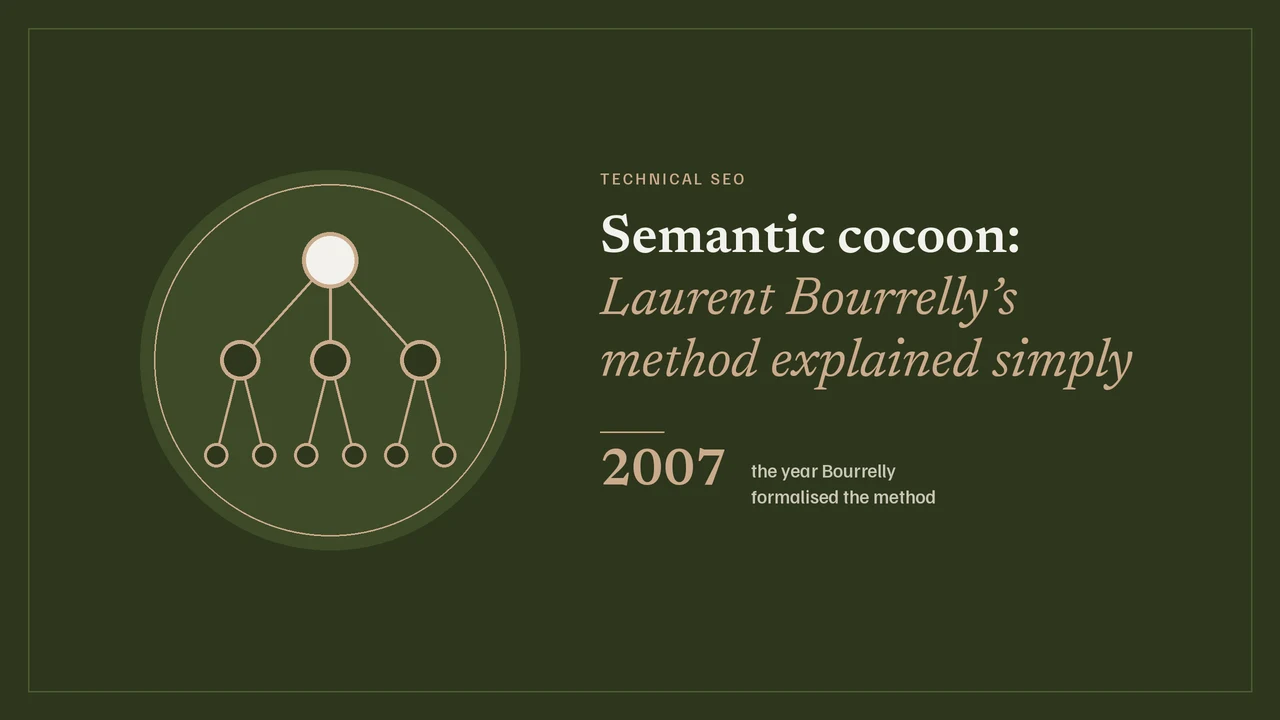
The semantic cocoon is a site architecture designed by French SEO consultant Laurent Bourrelly. It organises content as a pyramid around a parent keyword and then related topics, connected by internal links planned to concentrate topical relevance on the pages that matter. English-speaking SEOs will recognise a close relative of the silo structure and the topic cluster. Bourrelly began thinking about it in 2004, formalised the system in 2007 and released it to the public for free in 2012. His official definition fits in one sentence: « what relates to what, and why ». It is less a linking technique than a method for organising a site around search intent.
What is a semantic cocoon? The SEO method developed by Laurent Bourrelly

The official definition of the concept
On his blog, Laurent Bourrelly sums up the principle in a phrase he himself presents as the official version: « what relates to what, and why » (all his quotes here are translated from French). The idea is to make the organisation of the site match the way a searcher thinks, rather than the internal org chart of a company. Bourrelly stresses a point that comes up in several of his articles: « smart linking between pieces of content is the keystone of a website’s success ». The semantic cocoon is therefore not primarily about links, but a way of matching what a site offers to what searchers actually ask for, one piece of content at a time.
A method born in 2004 and made public in 2012
Laurent Bourrelly himself dates the origin of the concept to 2004, the year he started thinking about an approach to SEO based on semantics rather than on piling up links alone. He formalised a complete system in 2007 and applied it for his clients, before making it public and free in 2012. Since then he has kept publishing regular updates to his method, the latest dating from 2024, in which he notes that most sites claiming to use it do not get the expected results because there is no real strategy behind the structure.
How to build a semantic cocoon, step by step
Building a semantic cocoon starts before any writing, with mapping the topic. The method aims to rank a subject into several levels of editorial investment, from the broadest content to the most specific, before thinking about how the pages link to each other.
Choose the parent keyword and map the topic
The first step is to identify the parent keyword, the one that represents the broadest and most competitive subject within the theme. Around it, you list the subtopics that answer more precise search intents, then the even more specific questions attached to them. This mapping is usually done as a mind map, before anything is written, so you avoid creating pages that overlap or that have no logical place in the hierarchy of the topic.
Organise internal linking between the pages
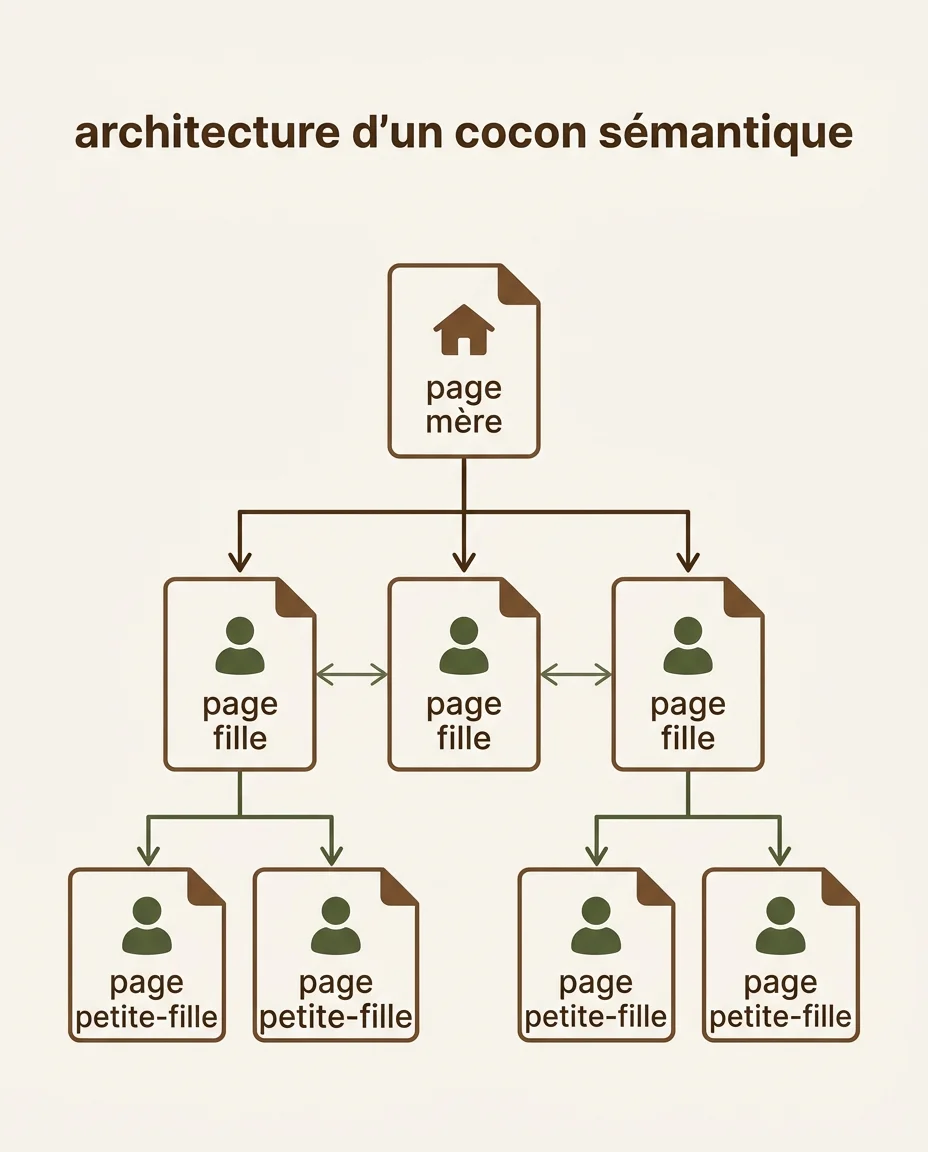
Once the pages are listed, you still have to decide which page links to which. In semantic cocoon practice as it has spread, the most frequently quoted rule is linking that flows down from the broadest content to the most specific, and stays sideways between pages of a comparable level, without systematically linking back up from a very specific page to a general one. Bourrelly puts this requirement in his own words: « internal linking must be crystal clear », and he warns against the opposite excess, a site where links multiply in every direction with no hierarchy behind them.
Semantic cocoon vs topic cluster vs silo: what are the differences?
The topic cluster, popularised by HubSpot from 2017 onwards, addresses a similar concern: grouping content by theme to signal its coherence to Google. The classic SEO silo follows the same instinct by separating sections that do not link to each other. The cocoon and the cluster share the idea of a reference page surrounded by supporting content, but they are not built the same way.
| Criterion | Semantic cocoon | Topic cluster |
|---|---|---|
| Origin | Laurent Bourrelly, France, developed from 2004 | HubSpot, United States, popularised in 2017 |
| Structure | Pyramid with several levels of specificity | One pillar page surrounded by cluster pages |
| Linking logic | Downward, and sideways between pages of the same level | Every cluster page links to the pillar page |
| Starting point | Semantic map of the topic before writing | List of subtopics tied to an existing pillar |
In both cases the end goal largely overlaps: showing a search engine that a site covers a subject in depth rather than through a single isolated piece of content. The choice between the two mostly depends on the SEO culture of the team putting them in place, and nothing stops you from combining both approaches on the same site.
Semantic cocoon on WordPress: how to apply it to your site
On WordPress, a semantic cocoon naturally relies on the site’s category structure: each category can act as the parent topic, and the posts filed under it become the more specific pages of the cocoon. The work then consists of adding links, within the body of the posts, to other content in the same category, rather than relying on the menu or category widgets to handle internal linking.
Before restructuring an existing site, a semantic audit lets you spot the pages that already cover the same subject from a different angle, those that should be merged, and those still missing to complete the pyramid. It is a useful first step before redistributing the internal links of a site that has grown without an overall plan.
Semantic cocoon mistakes that cancel out its effect
The first mistake is multiplying pages with no real difference in subject between them: two articles answering the same search intent cannibalise each other instead of reinforcing each other. The second concerns the linking itself. Bourrelly is blunt about sites that fail: « plenty of links going in every direction is not the right answer ». Dense linking with no hierarchy drowns the page that should receive the most internal weight among dozens of equivalent links.
The semantic cocoon is not about the number of links, it is about hierarchy. A parent page that receives links from ten child pages without returning the favour concentrates more relevance than a dense web of links where every page points to every other.
The third mistake is more strategic: building a semantic cocoon without first checking, through a semantic audit, which pages already exist and which would be better merged than duplicated. A cocoon built on a site that has never done this sorting often inherits the very duplicates it was supposed to solve.