Tom Lionne
Tool reviews
13 min read
Lucide AI review: the AI detector built for French texts, accuracy, features and pricing
Lucide AI review: the AI detector trained on French, AI passages highlighted, plagiarism, PDF and Word, API and MCP. Free up to 500 words, from €10 a month.
ChatGPT, Claude, Gemini, Mistral: in two years, AI has made its way into essays, theses, job applications and blog posts. To know who really wrote a text, you need a detector that understands the language it is written in. That is the whole idea behind Lucide.ai: an AI detector built in France, trained on hundreds of thousands of texts written in French, that highlights suspicious passages sentence by sentence and checks for plagiarism too. All from €10 a month, with a free detector to get started.
If you teach in a French-speaking school, buy French content for a website, recruit in France or review documents written in French, this is the detector designed for your texts. Lucide now also analyses Spanish. Here is what it can do, what each plan costs and who it is for.
- An AI-generated content detector specialised in French, now open to Spanish, built and hosted in France.
- An overall score, AI passages highlighted sentence by sentence and an explained verdict.
- Plagiarism detection, page-by-page analysis of PDF, Word and OpenOffice files, URLs and batches of files.
- An API and an MCP server included in every plan.
- A free detector up to 500 words, subscriptions from €10 to €150 a month and a 30-day Pass with no subscription at €19.
What is Lucide.ai?
Lucide.ai is an AI detector for French-language texts. You paste a text, drop a file or enter a URL, and in under a minute the tool tells you whether the content was written by a human, generated by AI or produced by a mix of both. It does not stop at a percentage: it shows you where to look and explains why.
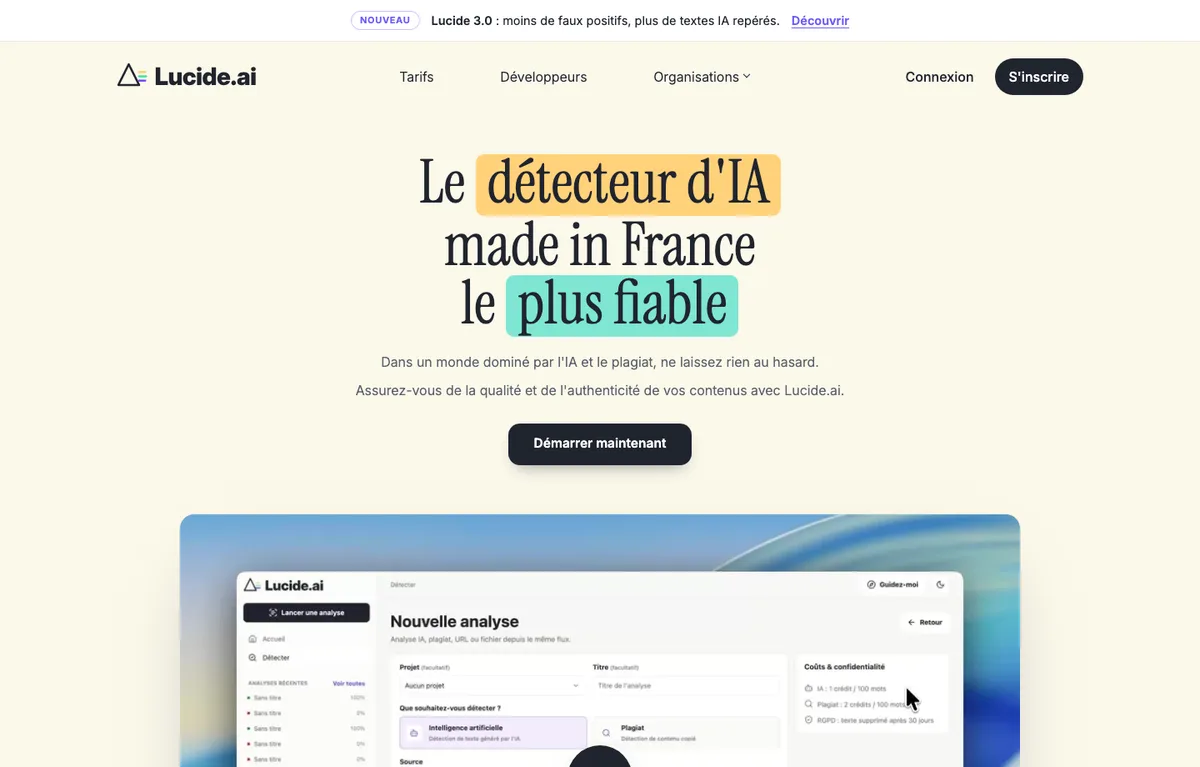
The tool is published by a young Paris-based company and has been online since late 2023. Its difference fits in one sentence: where most detectors on the market were designed for English and then adapted to other languages as best they could, Lucide was trained directly on French, without going through translations. Phrasing, punctuation, academic or journalistic registers: the model knows the habits of the language, and bases its judgement on them.
It was built by website publishing professionals, and that shows in how it is used. At first, the goal was to check that writers paid for human content were not delivering generated text, or quietly outsourcing it. The tool has since opened up to teachers, students, recruiters and legal teams.
More than 29,000 users rely on it, and version 3.0 of its model has just been released, with fewer false positives and more AI texts caught.
How the detector works
An analysis happens in three steps. You import your content (pasted text, a PDF or Word file, a page URL), Lucide reads it, then returns its verdict with a human-likeness score. An analysis usually takes between half a minute and a minute.
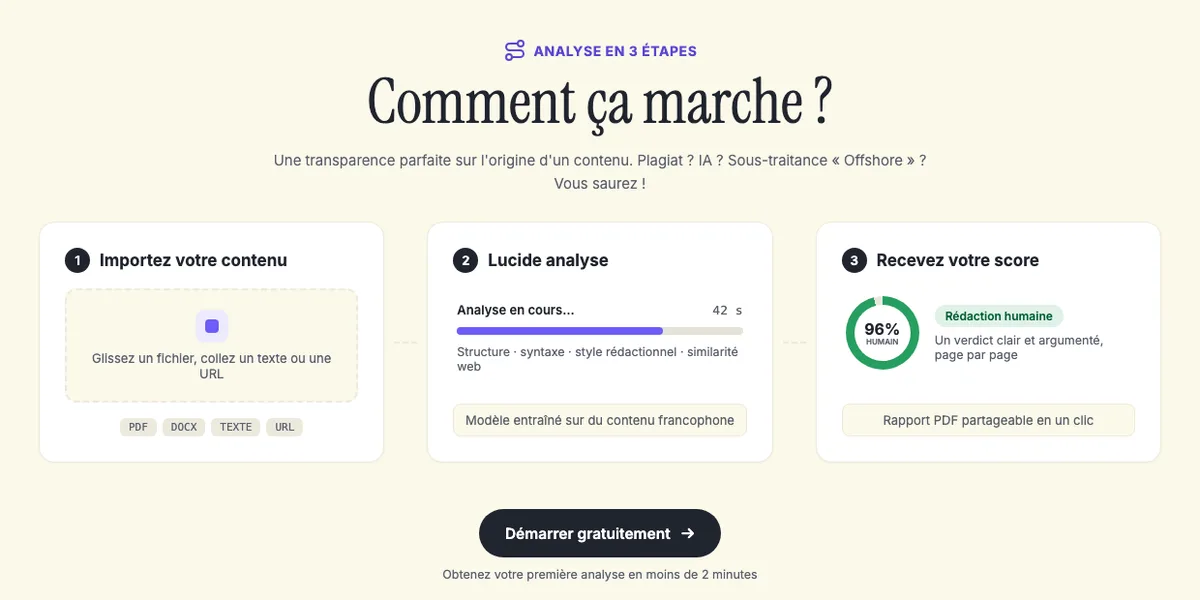
Under the hood, the text is first cleaned: the tool spots invisible characters and substitute letters, the tricks used to fool detectors (a Cyrillic « a » in place of a Latin « a », zero-width spaces). It then splits the text into sentences, reads each one with those around it, and classifies every sentence as human, edited or generated, before grouping them into passages.
This sentence-by-sentence reading is what lets Lucide handle today’s most common case: mixed text, partly written by AI then reworked by hand, or the other way round. An overall score is not enough for those texts; you need to know which part comes from where.
AI passages highlighted, sentence by sentence
This is the feature that most changes how you read a result. Instead of a simple percentage, Lucide displays the analysed text and highlights the passages that carry signs of AI writing, leaving the rest untouched. A filter lets you show only the AI passages, or only the human ones.
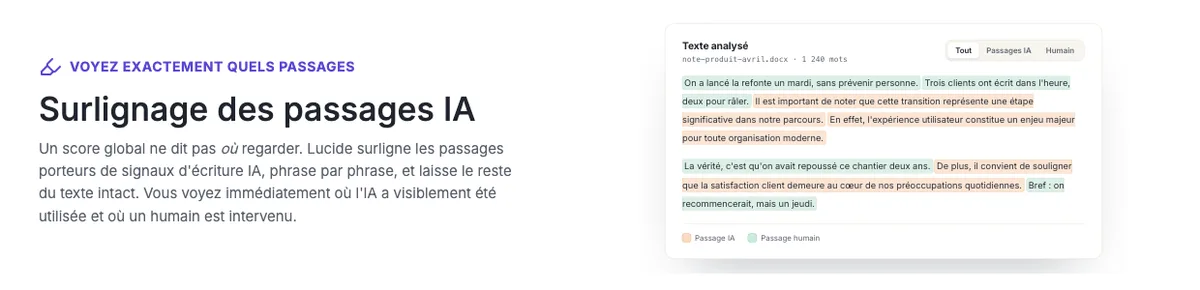
For a marker, it saves a great deal of time: you know straight away where to focus your reading. For a publisher, it is a way to talk with a writer, since you can show them exactly which sentences raise questions. And for a student who wrote everything themselves, it is a way to check that no passage risks being misread before handing in their work.
Each result comes with a written interpretation that explains what the tool spotted: a style that is too uniform, phrasing typical of language models, or on the contrary concrete details and a confident tone. The full report can be exported as a PDF and shared in one click.
Documents, URLs and bulk analysis
Lucide analyses PDF, DOCX, DOC and ODT files directly, with no copy and paste. The layout is preserved and the analysis runs page by page: on a fifty-page thesis, you see at a glance that 46 pages are judged human and that only one deserves a closer look, with its page number.
The tool also accepts a URL: handy for checking an article already published, a competitor’s page or a text a writer delivered straight online. And bulk analysis lets you drop a batch of files at once, such as forty essays from a class or a series of articles delivered by an agency.
Every analysed text stays in a history, organised in folders. You can come back to it, edit a text and scan it again: each text keeps the record of its successive analyses, which lets you follow the effect of a rewrite.
Plagiarism detection on top
A text can be written by a human and still not be original. Lucide therefore includes plagiarism detection: it searches the web for passages of the text that already exist elsewhere, and shows the matching source and the percentage of identical content.
For a website, it is protection against duplicate content before publishing. For a teacher, it is a second check that complements AI detection in the same tool, without juggling two subscriptions. Plagiarism detection is included from the Essentiel plan and in the 30-day Pass.
How reliable is it on French texts?
It is the question everyone asks, and Lucide answers it with a study published on its website: 11,000 texts, all in French, run through the main detectors on the market. The corpus covers the cases that really cause trouble: human texts, raw AI, AI « humanised » by a rewording tool, mixed texts, and several registers (academic, blog, LinkedIn posts). The AI texts were produced with the latest models from OpenAI, Anthropic, Mistral and DeepSeek.
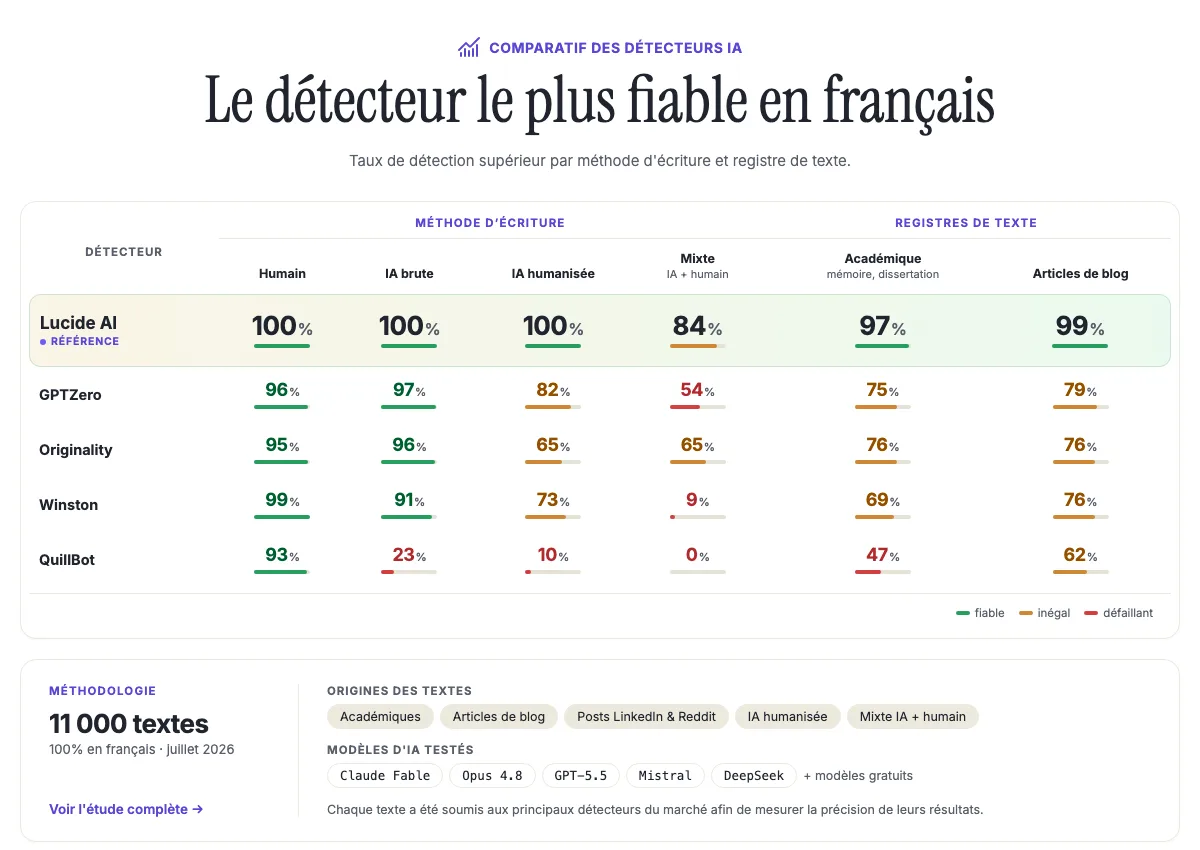
The results are clear. Lucide reaches 96% average accuracy, with 100% on human texts, raw AI and humanised AI, and 84% on the hardest case, the AI and human mix. Above all, its false positive rate (a human text wrongly flagged as AI) is only 0.3%. That is the most serious error for a detector, the one that can get a student accused of cheating or break trust with a good writer, and it is where Lucide pulls ahead on French texts.
Lucide is also honest about what a score is worth: it is an indication, not proof. The tool presents itself as decision support, and advises never to base a sanction on its result alone. That is the right way to use it, and the same rule applies to every detector.
The free detector
To get to know the tool, Lucide offers a free AI detector, with no sign-up, right on its website. It analyses up to 500 words (50 minimum) with a lighter model, already trained on French: it spots invisible characters, reads the text sentence by sentence and classifies the content as human, edited or generated.
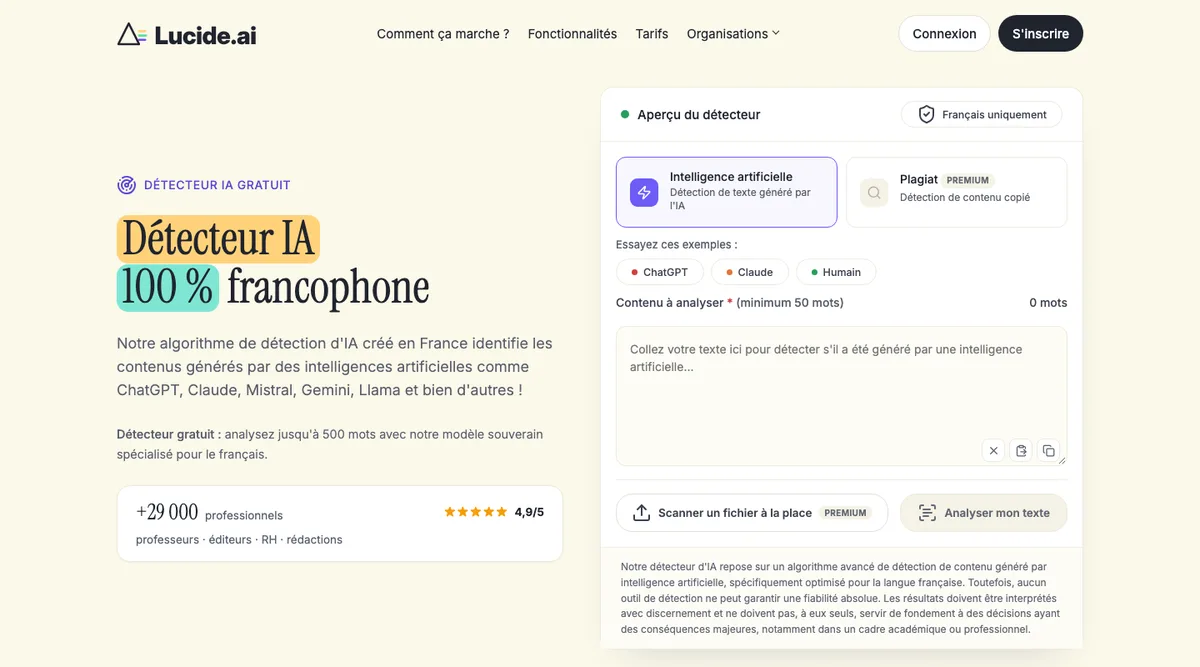
Ready-made examples (a ChatGPT text, a Claude text, a human text) show the tool at work in one click. It is ideal for a one-off check or to get a feel for it, but the features that make Lucide valuable are kept for paid plans:
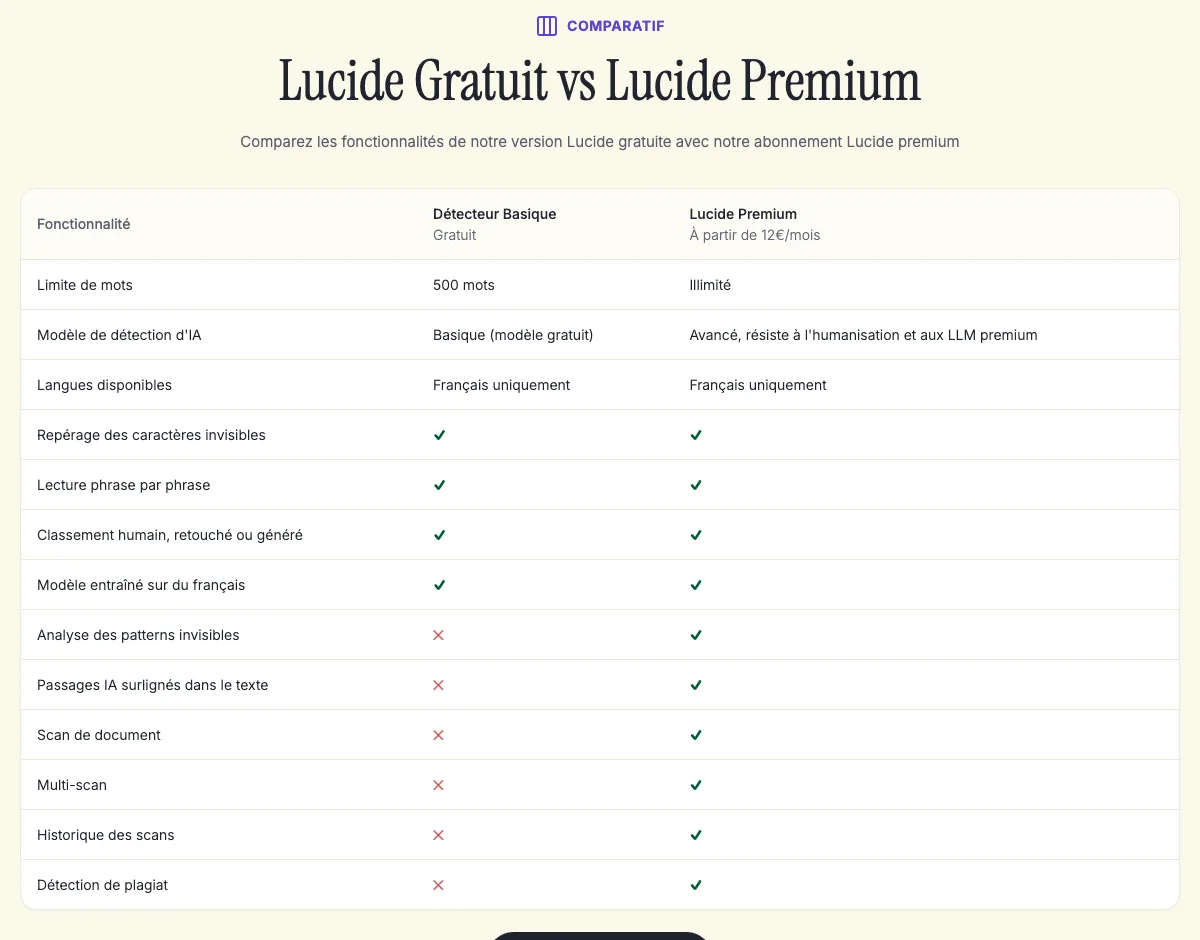
The main difference lies in the detection model: the premium version uses the advanced model, the one that holds up against humanised texts and the latest AI models. It is the one behind the study’s results.
An API and an MCP server to automate
Lucide goes beyond its web interface. A REST API lets you send texts from a script, a back office or a publishing pipeline, and get back the verdict, the score and the flagged passages. It is designed for serious integrations: keys with a spending limit, the option to replay a request without being charged twice, and the model version stated in each result.
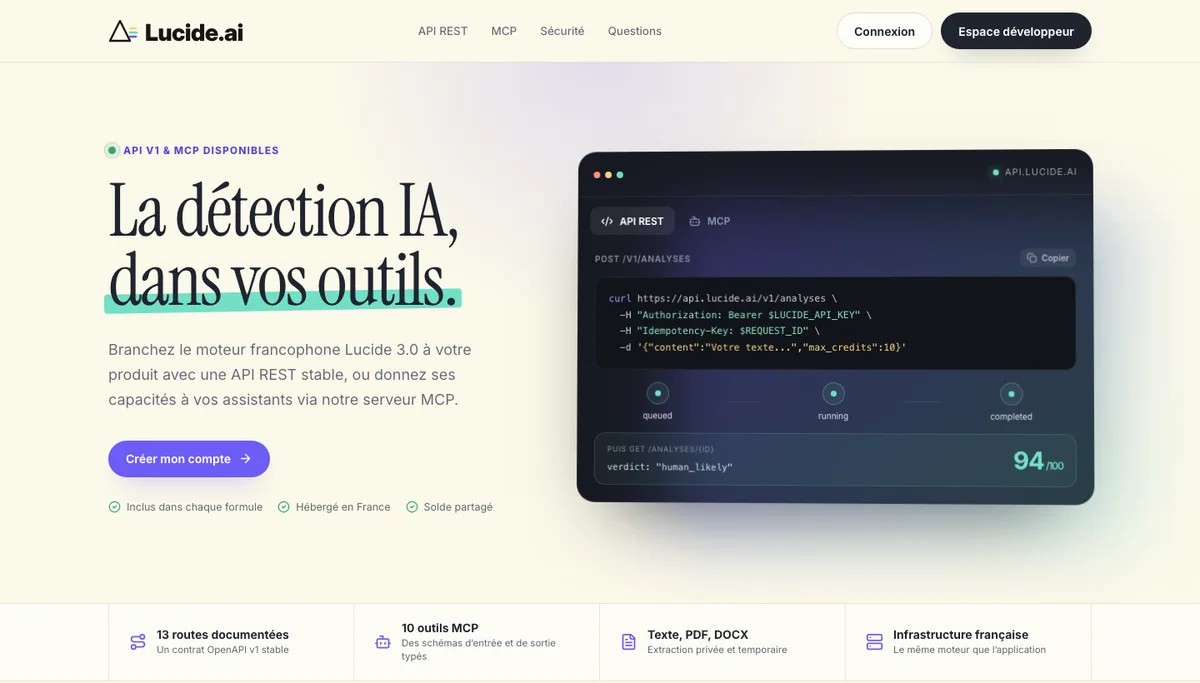
The MCP server goes further: it connects Lucide to an AI assistant such as Claude Code or Codex. Once the account is authorised, you simply ask « analyse this text with Lucide and show me the passages to check » to get the result in the conversation, and you can ask in English. For a content team that already works with an assistant, it is a quality check that fits in without changing tools.
Good point: the API and MCP server are included in every plan, 30-day Pass included, and draw on the same credit balance as the app.
Lucide.ai pricing
Lucide works with credits: one credit equals about 100 words analysed. A 1,500-word article therefore uses about fifteen credits. Three subscriptions are available, with no commitment and two months free on yearly billing, plus a Pass with no subscription for one-off needs. Lucide sells in euros, VAT included.
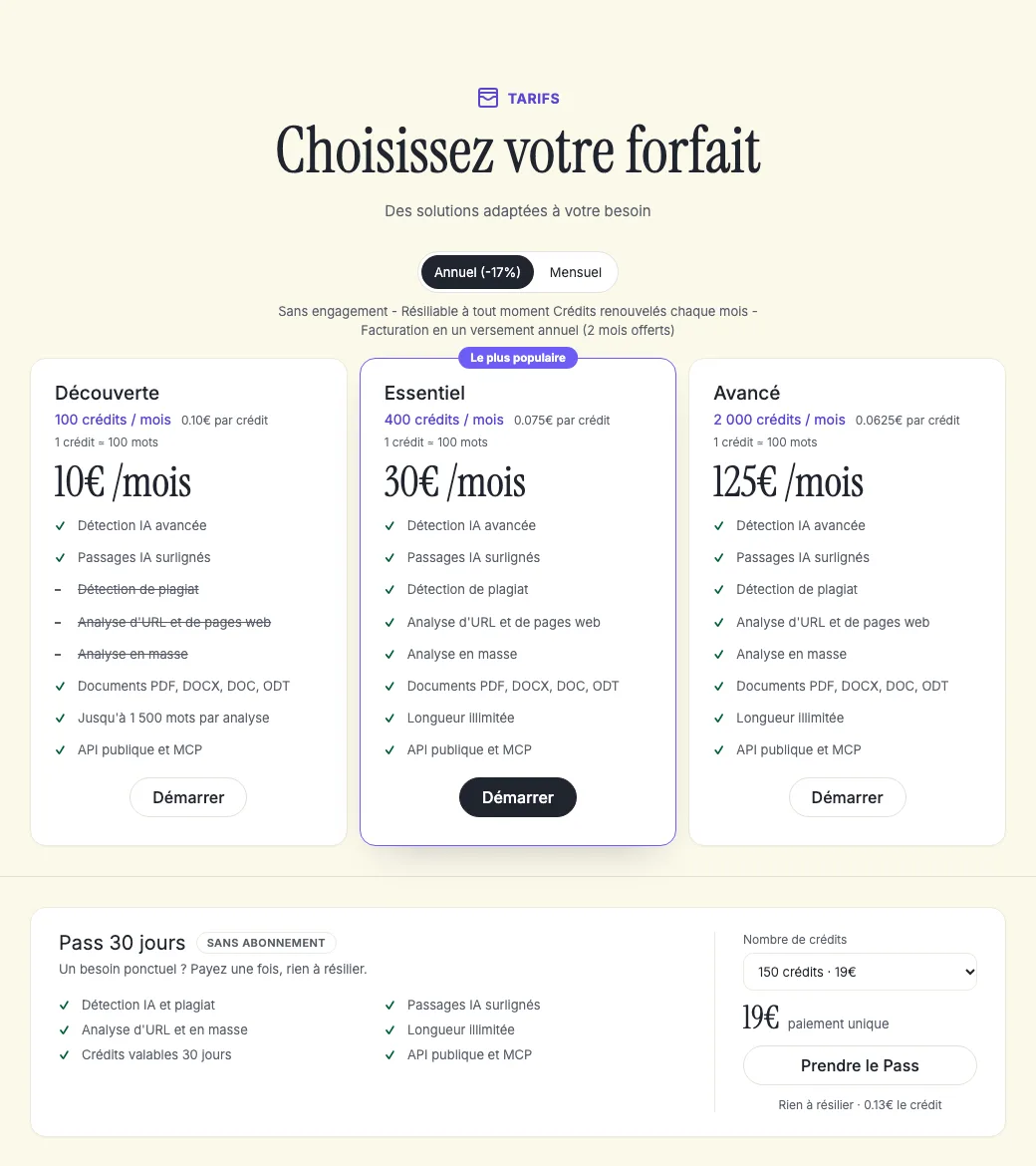
Here is the full grid:
| Plan | Credits | Monthly | Yearly | Best for |
|---|---|---|---|---|
| Découverte (Discovery) | 100 a month | €12 a month | €10 a month (€120 a year) | Regular checks of short texts, up to 1,500 words |
| Essentiel (Essential) | 400 a month | €36 a month | €30 a month (€360 a year) | Teachers, publishers and writers, with plagiarism and bulk analysis |
| Avancé (Advanced) | 2,000 a month | €150 a month | €125 a month (€1,500 a year) | Agencies, institutions and large volumes |
| 30-day Pass | 150 or 400 | €19 or €39, one-off payment | A one-off need: a thesis, a set of essays, an audit | |
The Essentiel plan is the most balanced, and also the most popular: 400 credits, or about forty 1,000-word texts a month, with no length limit, plagiarism detection, URL analysis, bulk analysis and two users. The Découverte plan suits short texts, but caps each analysis at 1,500 words and includes neither plagiarism, URLs nor batches. Avancé includes five users, and each extra user costs €7 a month.
The 30-day Pass is the right way in to try Lucide in depth: it opens every feature, unlimited length included, with nothing to cancel. Subscribers can also buy credit top-ups, which never expire. To estimate your needs, count the words of a typical text and divide by 100.
Who is Lucide.ai for?
Teachers and schools
This is its first audience: French and bilingual schools, universities in French-speaking countries, language departments. Page-by-page thesis analysis, batches of essays, PDF reports to keep: Lucide spots work written wholly or partly by AI without turning every marking session into an investigation. Its very low false positive rate is decisive here, because wrongly accusing a student is the worst possible outcome.
Students
More and more universities run assignments through a detector. A student who wrote everything themselves can check their thesis before handing it in, and keep the analysis as evidence if in doubt. The €19 30-day Pass is cut out for this.
Publishers, agencies and SEO teams
Buying French content from writers? Lucide checks that you receive what you pay for, and URL analysis checks an article directly online. If you produce French content yourself with AI, with a tool such as TextBulker, Lucide also helps measure the quality of an output and compare two prompts: a text judged human is often livelier and more concrete.
Recruiters and legal teams
Cover letters, written tests, tender responses, grant applications: Lucide helps you know whether a candidate or a supplier really wrote what they submit. For these uses, hosting in France and data that is never sold or used for advertising are real arguments.
Lucide.ai’s strengths
- A model trained on French, not adapted from English: that is what makes it accurate on French texts.
- Very few false positives: a human text is very rarely mistaken for AI.
- AI passages highlighted and an explained verdict, not just a percentage.
- AI and plagiarism detection in the same tool, on text, files and URLs.
- An API and an MCP server included in every plan, to automate checks.
- Hosted in France, with analyses you can delete at any time.
Things to know
Lucide specialises in French, now joined by Spanish: that is its strength, and it means it is built for texts in those languages rather than English. The website and the app are in French, with a Spanish version. There is no free trial of paid plans, but the free detector and the €19 30-day Pass play that role. Credits included in a subscription renew every month and do not roll over; only top-ups are kept indefinitely. Finally, as with any detector, the score is decision support, to be weighed against your own reading.
Getting started with Lucide
- Try the free detector on a text you know, human then generated.
- Take the 30-day Pass for a one-off need, or the Essentiel plan for regular use.
- Analyse your files as they are, in PDF or Word: page-by-page reading saves precious time.
- Read the highlighted passages rather than the score alone, with the interpretation that comes with it.
- Sort your analyses into folders, by writer, class or client.
- Connect the API or MCP server if you check regular volumes.
Lucide.ai vs the alternatives
| Tool | The right choice if… |
|---|---|
| Lucide.ai | Your texts are in French or Spanish and you want as few false positives as possible |
| GPTZero | You mainly analyse texts in English |
| Originality.ai | You manage multilingual content for an English-language site |
| Compilatio | Your institution has already built it into its assignment platform |
To compare more writing and AI tools, browse all my tool reviews.
Lucide.ai FAQ
Is Lucide.ai free?
The basic detector is free with no sign-up, up to 500 words per analysis. Advanced features (premium model, highlighted passages, files, plagiarism, history) require a subscription from €10 a month, or the 30-day Pass at €19.
How much does Lucide.ai cost?
From €10 a month billed yearly (€12 month to month) for Découverte, €30 (€36) for Essentiel and €125 (€150) for Avancé, VAT included. The 30-day Pass costs €19 or €39, with no subscription.
Does Lucide work on English texts?
No, Lucide specialises in French and now Spanish. That choice is what makes it so accurate on those languages. For English texts, a detector trained on English is the better fit.
Does Lucide detect ChatGPT, Claude and Gemini?
Yes. Lucide identifies texts produced by ChatGPT, Claude, Gemini, Mistral, Llama, DeepSeek and AI writing tools, including when they have been reworded to look human.
How many words does a credit cover?
One credit equals about 100 words. A 2,000-word text uses about twenty credits.
Lucide vs GPTZero: which one should you choose?
For French texts, Lucide: its model is trained on the language and keeps false positives very low. For English texts, GPTZero is designed for that language.
Are my texts stored?
They stay in your history, hosted in France, and you can delete each analysis whenever you like. They are never sold, shared or used for advertising.
My verdict on Lucide.ai
Lucide.ai is the AI detector to choose for texts written in French. Trained on the language, it catches raw AI as well as humanised or mixed texts, with a remarkably low false positive rate, and it shows the passages in question precisely instead of settling for a score. Plagiarism detection, page-by-page file analysis, the API and the MCP server make it a complete tool, as useful to a teacher as to a content agency.
Start with the free detector, then take the 30-day Pass for a one-off need or the Essentiel plan for regular use: it is the best balance between price and features.
Want to know who really wrote your French texts?
An AI detector specialised in French, with plagiarism, files and API, from €10 a month or €19 with no subscription.
The Lucide.ai links on this page are affiliate links: if you subscribe through them, I earn a commission, and you pay the same price. My opinion remains my own.