Tom Lionne
Tool reviews
13 min read
Semrush review: keyword research, competitor analysis, AI visibility and pricing
Semrush review: keyword research, competitor analysis, Site Audit, AI visibility in ChatGPT and Gemini, SEO, Starter and Pro+ pricing, free account and 7-day free trial.
Before writing an article, launching a new section or rebuilding a website, the same question always comes up: is anyone actually searching for this, and who already holds the spot? Semrush answers that question with data. Search volumes, keyword difficulty, competitors’ estimated traffic, backlinks, the technical health of a site, and now a brand’s presence in AI answers: it all sits in one suite, built on a database of nearly 29 billion keywords across 142 countries and regions.
Consultants, agencies, publishers and online stores use it to pick their topics, analyse their competitors, fix their sites and track their rankings. Here is what each major feature does, what the plans cost, how to read the tool’s numbers well and who it really serves.
- A complete SEO suite launched in 2008, now an Adobe company.
- Keyword research, competitor analysis, backlinks, technical audits and rank tracking in one tool.
- An AI visibility module covering ChatGPT, Gemini, Perplexity and Google’s AI Overviews.
- Plans from $139 a month, or $117.33 a month billed yearly, plus a free account and a 7-day free trial.
- Ideal for making fast, data-backed decisions: what to write, who to watch, what to fix.
What is Semrush?
Semrush started in 2008 as an in-house tool, built by two search enthusiasts for their own use. It grew into an American company headquartered in Boston, listed on the New York Stock Exchange in 2021, then acquired by Adobe in 2026. Along the way, the tool expanded through acquisitions and its own development: it now claims more than 100,000 paying customers in over 150 countries. Adobe has stated that features, interface, billing and existing contracts stay the same: subscribers keep the tool they know.
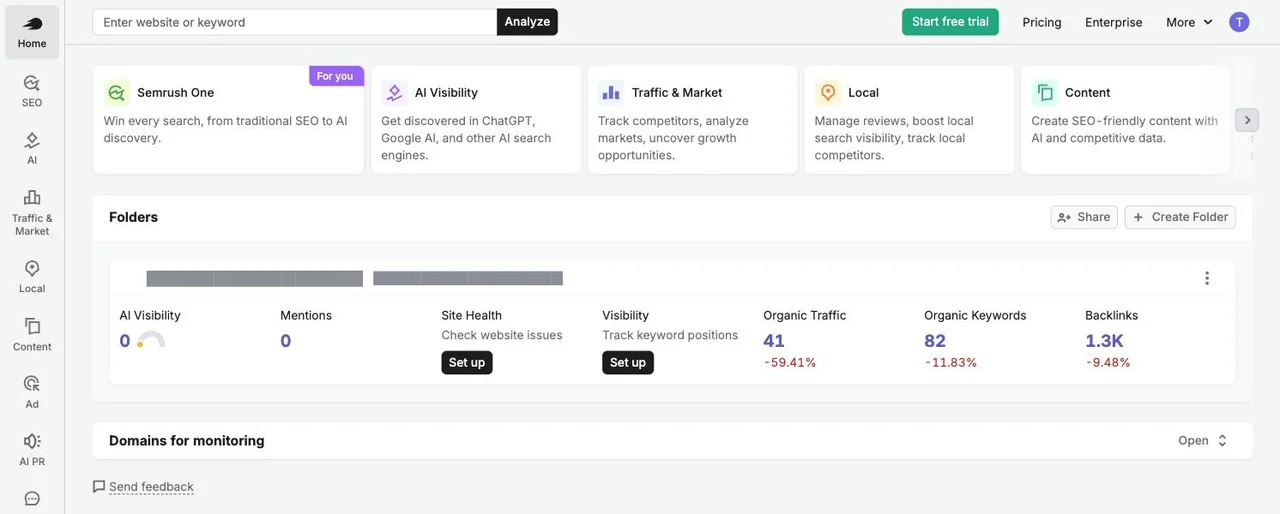
In practice, Semrush brings together dozens of tools organised into « toolkits ». The SEO toolkit is the core of the offer, and the one this review focuses on. Around it sit other modules sold separately: AI visibility, traffic and market analysis, local SEO, content, social media and advertising. Since 2025, Semrush One has combined the SEO toolkit and AI visibility in a single plan.
Keyword research
This is the most used feature in Semrush, and the one that justifies the subscription on its own for many publishers. The Keyword Magic Tool starts from a single word and returns every related search, each with:
- the average monthly search volume;
- the keyword difficulty, as a percentage;
- the search intent (informational, navigational, commercial, transactional);
- the cost per click in paid search and the trend over the year.
Filters let you isolate questions, keep only the easy keywords, exclude a brand or a word, and group results by topic. In a few minutes, you go from a vague idea to a list of topics ranked by potential.
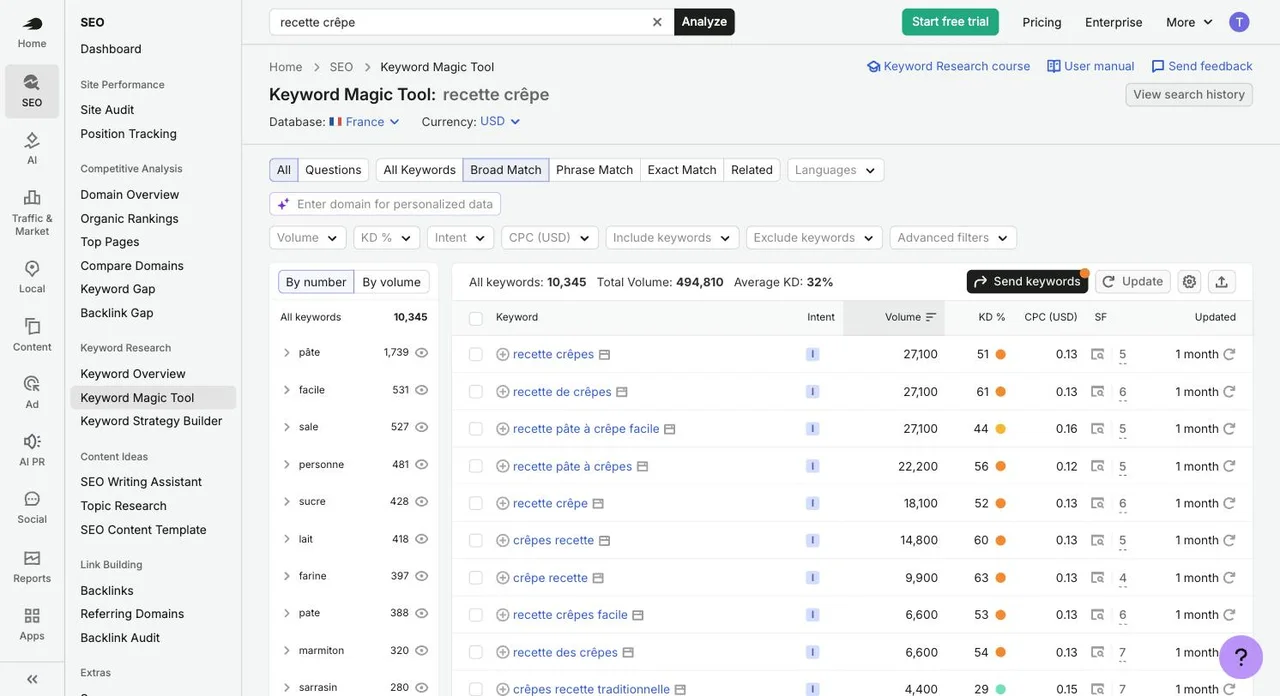
The database switch matters: the same tool works on the US, UK, France or any of the 142 country databases, so you can research a market whose language you do not write in every day. The Keyword Overview page for a keyword adds volume by country, variations and the Google results page, so you can see who already ranks. The numbers are estimates based on a twelve-month average: they are made to compare topics and set priorities, which they do very well.
Competitor and domain analysis
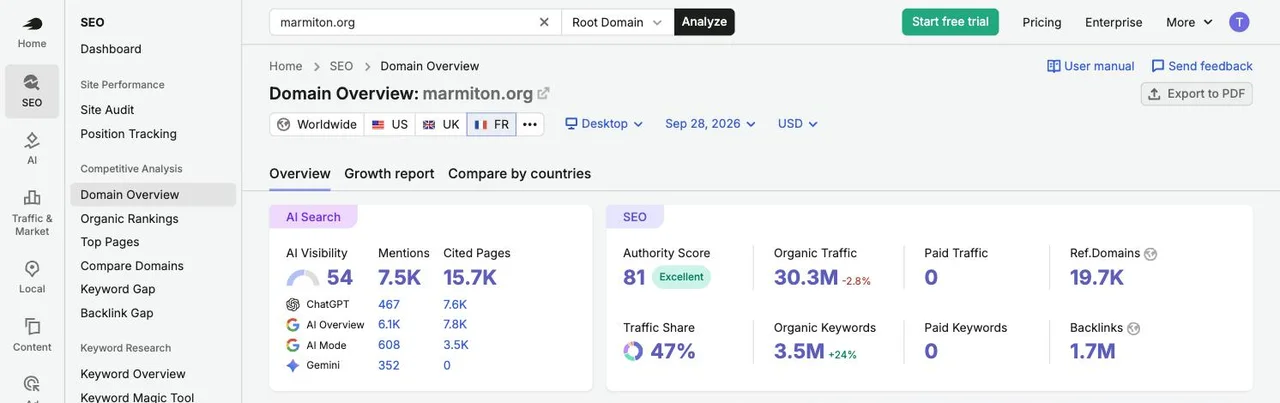
Type in any domain name and Semrush gives you a snapshot: estimated organic traffic, number of ranking keywords, Authority Score (its own strength rating, from 0 to 100), backlinks and main competitors. This is the Domain Overview, and it is often the first thing to check before entering a market.
To go further, three reports do the work:
- Organic Rankings: every keyword a site ranks for, with the position and the page that ranks;
- Top Pages: the pages that bring a site the most traffic, ideal for spotting what works for a competitor;
- Keyword Gap: your site against up to four competitors, with the list of keywords where they rank and you do not. It is a goldmine of article ideas, already sorted.
Within an hour, you know what works in your niche and what is still up for grabs.
Backlinks
Semrush indexes tens of trillions of links and crawls around ten billion pages a day. Backlink Analytics shows the link profile of any site: referring domains, anchors, most linked pages, and links gained and lost over time. Backlink Gap applies the Keyword Gap logic to links: it lists the sites that link to your competitors but not yet to you, a solid starting point for a link building campaign. Finally, Backlink Audit flags questionable links pointing to your site.
A solid base for any link building work, to be paired with a manual review of the links that matter most.
Site Audit and rank tracking
Site Audit sends a crawler through your site, then sorts what it finds into errors, warnings and notices: broken pages, redirect chains, missing or duplicate title tags, near-duplicate content, heavy images, broken internal links. Each issue comes with an explanation and a fix, and a health score tracks your progress from one audit to the next. The entry plan crawls up to 100,000 pages a month.
Position Tracking records the daily ranking of your keywords in Google, on desktop or mobile, at country or city level. You add your competitors to compare the curves, and alerts warn you when a position moves sharply. The Pro+ plan adds keyword cannibalization analysis, for when two of your pages compete for the same keyword.
AI visibility
This is the most striking change in Semrush lately. A share of searches now goes through ChatGPT, Gemini, Perplexity or the answers generated at the top of Google. The AI Visibility toolkit measures your brand’s place in those answers:
- the number of mentions of your brand and your competitors across six AI platforms;
- daily tracking of prompts, the typical questions people ask AI assistants about your industry;
- how AI models perceive your brand: the tone they use and the accuracy of what they say;
- prompt research, to find out what people really ask AI assistants, with an estimated volume.
The Domain Overview already gives a preview, next to the classic metrics: a good starting point to find out whether ChatGPT mentions a brand.
Semrush pricing
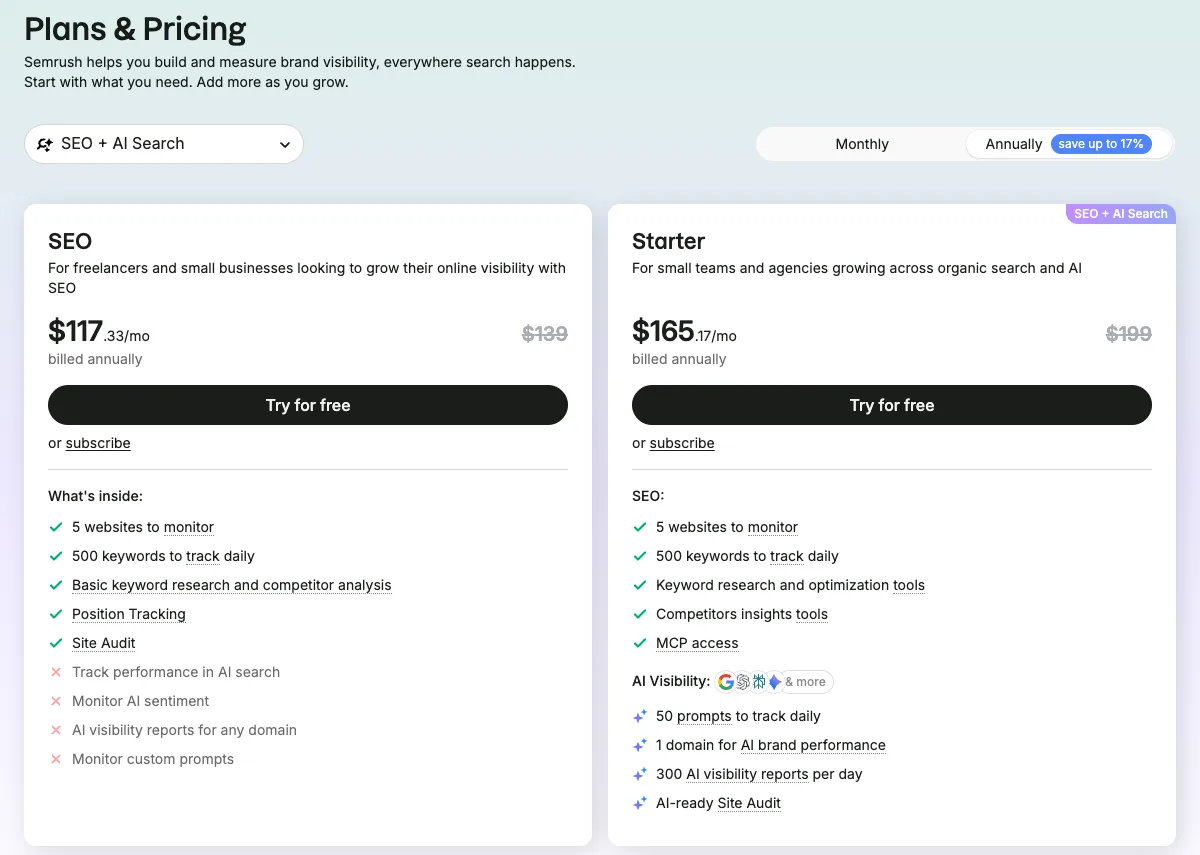
Semrush’s main pricing page now groups its plans under SEO + AI Search. Prices are in US dollars, excluding taxes, and yearly billing saves up to 17%.
| Plan | Billed monthly | Billed yearly | Websites | Keywords tracked |
|---|---|---|---|---|
| SEO | $139 a month | $117.33 a month | 5 | 500 |
| Starter (Semrush One) | $199 a month | $165.17 a month | 5 | 500 |
| Pro+ | $299 a month | $248.17 a month | 15 | 1,500 |
| Advanced | Custom quote | 40 | 5,000 | |
The SEO plan suits freelancers, publishers and small businesses: keyword research, competitor analysis, rank tracking, backlinks and Site Audit. Starter is the entry point to Semrush One: the same SEO limits, plus MCP access, 50 AI prompts tracked daily, one domain in AI brand tracking and an AI-ready Site Audit. Pro+ adds historical data, multi-location and multi-device tracking, content optimisation and cannibalization analysis, with 100 prompts a day, for consultants and agencies handling several clients. Advanced targets large teams: share of voice, API access, automation and unlimited prompt tracking.
Inside the account, the classic SEO grid still uses the former plan names, which you will meet in the knowledge base and many guides: Pro corresponds to SEO, Guru to Pro+ and Business to Advanced, with the same limits of 5, 15 and 40 websites. Other toolkits can be added on their own, such as AI Visibility from $99 a month per domain billed yearly.
Free plan, trial and refunds
The free account only needs an email address: 10 requests a day in the analytics reports, one project and 10 keywords in Position Tracking. It is perfect for exploring the interface or checking a keyword now and then.
The 7-day free trial unlocks the full tool on the SEO, Starter and Pro+ plans. A credit card is required at sign-up, with a small verification charge refunded straight away, and the subscription starts at the end of the trial unless you cancel from your account. For a first yearly subscription, Semrush also offers a 7-day money-back guarantee.
See the data for yourself
Seven days of full access to keyword research, competitor analysis, Site Audit and rank tracking.
Semrush’s other toolkits
Beyond SEO, Semrush sells several toolkits à la carte, which you can add to any plan. Each one serves a specific job:
- Local: Google Business Profile management and review tracking, from $30 a month per location billed yearly;
- Content: help with writing and optimising copy, from $60 a month billed yearly;
- Traffic & Market: estimates of a site’s total traffic across all channels and market analysis, from $289 a month billed yearly;
- Social and Advertising: post scheduling on social networks, and management of Google and Meta ad campaigns.
This split means you only pay for what you use. An SEO consultant often sticks with the SEO toolkit, a local business adds Local, and a brand that wants to be cited by AI picks Semrush One.
Semrush is my everyday data tool for around sixty websites: the Keyword Magic Tool to choose topics, Organic Rankings and Top Pages to follow competitors. To decide whether to keep, merge or remove a page, I cross its estimated traffic with Search Console. And the data made me drop, just in time, a structure of more than a hundred local pages that would each have topped out at about twenty searches a month: deciding before investing is the whole point of the tool.
What we like about Semrush
The breadth and depth of the data
Nearly 29 billion keywords across 142 geographic databases: you will find data on almost every topic, niches included, and in almost every market.
All of SEO in one tool
Keywords, competitors, backlinks, technical audits, rank tracking, content: Semrush alone replaces several subscriptions. The reports connect to each other, and you move from a keyword to the page that ranks for it, then to that page’s links, in a few clicks.
The most telling competitor analysis
Keyword Gap, Top Pages and Organic Rankings turn other sites’ success into an action plan. For finding topics that already work, it is remarkably effective.
A head start on AI visibility
Measuring your place in ChatGPT, Gemini, Perplexity and the AI Overviews is becoming a priority for every brand. Semrush already builds it into the tool, next to classic SEO, with daily tracking.
Client-ready reports
Scheduled PDF reports, Google Analytics and Search Console integrations, a Looker Studio connector and white-label reports as an add-on: a consultant or an agency can present results to a client straight from the tool.
Things to know
A budget to plan for
From $117.33 a month billed yearly, Semrush is made for people who get value from it every week. For occasional use, the free account helps out, and shared-access services such as RankerFox open several premium SEO tools at a low price when you only need them from time to time.
One user per plan
Each plan includes a single user. Extra team members are paid on top, from $45 a month depending on the plan. An agency builds it into its budget from the start.
A trial that needs a card
The 7-day trial starts with a credit card, and the subscription begins automatically when it ends. Note the end date, and cancel from your account if the tool is not for you.
A few weeks to get comfortable
The interface is dense, because the tool does a lot. Start with three reports (Keyword Magic Tool, Domain Overview, Organic Rankings), then branch out: after a few weeks, you find your way without thinking. Semrush Academy offers free courses to speed things up.
Who Semrush is for
Ideal for
- SEO consultants who follow several clients and need to back up their recommendations
- Agencies that want one tool for audits, tracking and reporting
- Publishers who choose their topics every week
- Online stores that watch their competitors and categories
- Brands that want to measure their presence in AI answers
Less suited to
- A personal blog that publishes one article a month
- An occasional need for a few keywords per quarter
- A budget of a few dozen dollars a month
- A large team sharing a single plan
My tips for getting the most out of Semrush
- Pick the right database: volumes and rankings change from one country to another. Check whether you are on the US, UK or another database before every search.
- Always cross-check with Search Console: estimated traffic lags a few weeks behind your real clicks. For your own sites, Search Console has the final word; for competitors, Semrush sheds the light.
- Read intent with the results page in front of you: the Intent column gives a trend, and Google’s results page confirms the type of content expected.
- Choose your seed keyword carefully: a word that is too short drifts into other topics. For a local topic, combine a trade and a city or county to bring out the real searches.
- Go for easy keywords first: on a young site, filter for low difficulty and build authority before tackling competitive queries.
- Use the trial to explore everything: create a project, run an audit, track your keywords and compare yourself with competitors during the 7 days.
Semrush vs the alternatives
Other tools cover more focused needs or tighter budgets very well.
| Tool | Main strength | The right choice if… |
|---|---|---|
| Semrush | All SEO and AI visibility data in a single suite | You make SEO decisions every week |
| Ahrefs | A very large backlink index and a clean interface | Links are at the centre of your work |
| SE Ranking | A complete suite at a lower entry price | You want most of the features for less |
| Mangools | Simple, friendly keyword and SERP tools | You are starting out in SEO |
| Ranxplorer | Data focused on Google France | You target French-speaking markets |
| Surfer | Optimising every article for Google and AI answers | You write and update content regularly |
| DataForSEO | Pay-as-you-go SEO data by API, MCP server included | You want the data in a spreadsheet, your own tool, or Claude and ChatGPT |
Semrush covers the whole world and goes furthest on AI visibility; the others shine on a narrower field. To compare more tools, browse all my tool reviews.
Semrush FAQ
How much does Semrush cost?
The SEO plan costs $139 a month, or $117.33 a month billed yearly. Starter, which adds AI visibility through Semrush One, costs $199 ($165.17 billed yearly), and Pro+ costs $299 ($248.17 billed yearly). Advanced is priced on quote.
Is Semrush free?
A free account exists, with no credit card: 10 requests a day in the analytics reports, one project and 10 tracked keywords. For the full tool, the 7-day free trial opens the paid plans.
How does the 7-day free trial work?
You choose a plan and enter a credit card, checked with a small charge that is refunded straight away. You get the full tool for 7 days, then the subscription starts, unless you cancel from your account before the trial ends.
Semrush vs Ahrefs: which one should you choose?
Semrush is the broader suite: keyword research, competitor analysis, audits, local, content, advertising and AI visibility. Ahrefs is the reference for backlink analysis. If your work covers all of SEO, Semrush is the more complete choice.
What is the difference between SEO and Pro+?
Pro+ triples the number of tracked websites and keywords (15 and 1,500 against 5 and 500), and adds historical data, multi-location tracking, content tools and AI prompt tracking. SEO is enough for a freelancer; Pro+ suits consultants and agencies.
Is Semrush data accurate?
The figures are estimates, built on a very large database and a twelve-month average. They are reliable for comparing topics, spotting trends and analysing competitors. For your own sites, cross-check them with Search Console, which shows your real clicks.
Is Semrush owned by Adobe?
Yes, Semrush became an Adobe company in 2026. Adobe has stated that the tool, interface, billing and existing contracts stay the same for subscribers.
Can I get a refund?
Semrush offers a 7-day money-back guarantee on a first yearly subscription. On monthly billing, the free trial plays that role: it lets you check the tool suits you before the first payment.
My verdict on Semrush
Semrush is the reference data tool for deciding on numbers rather than gut feeling: which topics to write, which competitors to watch, which pages to fix, and now how your brand shows up in AI answers. For a consultant, an agency, a publisher or an online store making this kind of decision every week, the subscription pays for itself quickly, often with the first pointless project it helps you avoid.
Semrush delivers on its promises: wide data, reports that connect from one module to the next, and a real lead on AI visibility. Plan the budget and a few weeks to get comfortable, and use the 7-day trial to form your own opinion.
Ready to decide on data?
Keyword research, competitor analysis, Site Audit, rank tracking and AI visibility: 7 days to explore it all.