Tom Lionne
Technical SEO
7 min read
Google algorithm updates history: Panda, Penguin, BERT, MUM and HCU explained
Google algorithm updates history from Panda to the latest core updates: what each one changed, who it hit, and how to respond calmly when the next one rolls out.
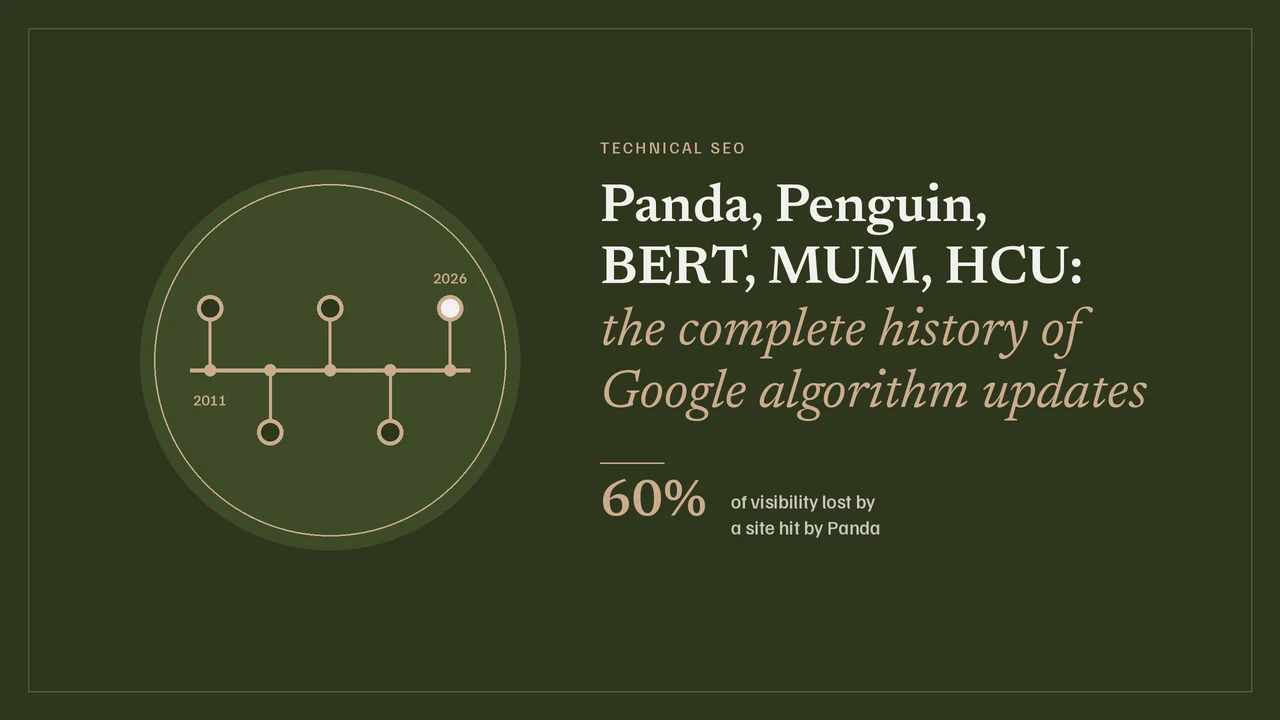
Since 2011, around fifteen major algorithms have redefined organic search. Panda penalised thin content, Penguin bought links, Hummingbird and then BERT moved Google from matching words to understanding meaning, and the 2022 Helpful Content Update shifted the verdict from the text itself to the intent behind it. Since 2023, core updates have followed one another every two to four months and absorbed the old filters: there is no longer an isolated penalty to fix, but an overall assessment that is replayed constantly.
Google algorithm updates timeline: the complete history from 2011 to 2026
This timeline keeps only the updates whose effect was measured and confirmed. Google rolls out several hundred adjustments a year, but fewer than twenty have changed the way SEO work is done.
Google algorithm history: what each update actually changed
Reading this list as a series of penalties would be a mistake. Each update fixes a problem created by the previous generation of optimisation tactics, and three periods stand out clearly.
2011 to 2015: policing quality
Google discovered that its ranking could be manipulated on a massive scale, and responded with targeted filters.
| Update | Date | Target | Visible effect |
|---|---|---|---|
| Panda | February 2011 | Thin content, content farms | Whole sites dropped, not isolated pages |
| Penguin | April 2012 | Artificial links, over-optimised anchors | Link networks collapsed |
| Hummingbird | August 2013 | Conversational queries | End of ranking by word matching |
| Pigeon | July 2014 | Local results | Local ranking brought closer to classic ranking |
| Mobile Friendly | April 2015 | Mobile compatibility | Non-adapted sites demoted on mobile |
Panda and Penguin share a trait that surprised people at the time: they hit at domain level. A site could lose sixty per cent of its visibility because of a few thousand generated pages it had forgotten about.
2015 to 2021: understanding language
The focus changed. It was no longer about spotting cheating but about understanding what the person typing actually wants.
| Update | Date | Contribution |
|---|---|---|
| RankBrain | October 2015 | First machine learning component in ranking, handling never-before-seen queries |
| Medic | August 2018 | Reliability requirements on health and finance, reputation enters as a criterion |
| BERT | October 2019 | Reading the context of a word within the sentence, prepositions included |
| Product Reviews | April 2021 | Distinction between a real test and a rewritten product page |
| Page Experience | June 2021 | Performance and visual stability signals integrated |
| MUM | Announced May 2021 | Multimodal, multilingual model, rolled out gradually and rarely isolatable |
MUM deserves a clarification many articles leave out: unlike Panda or Penguin, it never came with a dated, measurable rollout. It is an architecture that feeds several features, not a filter that hits you on a Tuesday morning.
Page Experience, by contrast, produced a modest and much-discussed effect. Core Web Vitals do count, but as a tie-breaker between equivalent content, never as a substitute for relevance.
2022 to 2026: helpfulness, then AI
| Update | Date | Shift |
|---|---|---|
| Helpful Content Update | August 2022 | Judging the intent behind the writing, a site-wide signal |
| Link Spam, SpamBrain | December 2022 | Artificial links neutralised rather than penalised |
| March 2024 core update | March 2024 | HCU absorbed into the core, new anti-spam rules |
| AI Overviews | May 2024 in the United States, July 2026 in France | Generated answer above the links, a new measure of visibility |
| 2025 core updates | March, June, December 2025 | Content with original value, decline of authority-domain parasitism |
| 2026 core and spam updates | March then May 2026 | Mass-produced synthetic content, manipulation of AI answers |
A word of caution on method
Updates before 2023 are documented and confirmed by Google. For 2025 and 2026, most impact analyses come from third-party tracking tools and the specialist press, each with its own sample. Rollout dates are reliable; interpretations of what was targeted are far less so.
Panda, Penguin, BERT: the three foundations that still shape SEO

Panda, Penguin and BERT form the foundation that is still active today, even though none of the three exists any more as a standalone filter. All three were built into the core algorithm, which makes them permanent rather than periodic.
Panda and site-wide quality
Panda’s lasting contribution fits in one sentence: quality is judged at domain level, not page level. Five hundred excellent pages buried among five thousand empty ones make a mediocre site in Google’s eyes.
That is why deindexing weak pages in bulk is still, today, one of the few moves that produces a fast, measurable effect. The principle has not changed since 2011; only the detection has become sharper.
Penguin and the link profile
Penguin first penalised, then, from its 2016 version built into the core, mostly neutralised. The difference is crucial: in most cases an artificial link no longer costs you a penalty, it simply stops counting.
The practical consequence today: disavowing links, long a systematic reflex, is only worth doing when a manual action has been notified in Search Console. The risk is no longer a penalty, it is wasted investment.
BERT and the intent behind the query
BERT put an end to a fifteen-year-old practice: targeting each keyword variant with its own page. Once the engine understands that two different wordings express the same request, publishing two pages means competing with yourself.
It is also what made exact-match keyword linking obsolete in favour of organising content by topic. In France, the best-known formalisation of that idea is the semantic cocoon, a close cousin of the topic cluster.
Helpful Content Update: the 2022 turning point
The Helpful Content Update is the most misunderstood update on the list, because its name suggests it assesses the quality of the text. That is not what it does.
What the HCU really penalised
The HCU assesses the intent behind the writing: does the content exist because someone had something to say, or because a query had search volume? A text that was flawless in form, well researched and well written could be hit if it merely rephrased the consensus already available elsewhere.
Two features made this filter formidable. It applies to the whole site, so a few dozen articles produced for volume also drag down legitimate content. And it was a classifier: once flagged, a site had to wait for a new pass to be reassessed, sometimes several months after fixing the problem.
Folded into the core algorithm in March 2024
In March 2024, Google announced that HCU signals were being integrated into its core ranking systems. The separate filter disappeared and its criteria became permanent.
The good news is the end of the waiting: assessment is continuous again. The bad news is that there is no longer an identifiable exit date, so no moment when you can say you have recovered. The same move came with three explicit anti-spam rules, covering scaled content production, the abuse of a domain’s reputation by third parties, and the purchase of expired domains.
Core updates from 2023 to 2026: what trends stand out?
Four lines of force run through the updates of the last three years, and they grow stronger from one iteration to the next.
| Trend | What is targeted | What benefits |
|---|---|---|
| Original value of content | Summaries of the consensus available elsewhere | First-hand data, real testing, figures you measured yourself |
| Reputation of the author and the site | Sensitive topics handled without legitimacy | Identifiable bylines, a clearly readable specialism |
| End of authority parasitism | Third-party content hosted on powerful domains | Sites that publish under their own responsibility |
| Mass-produced synthetic content | Generated volume with no editorial input | Content that is reworked, checked and grounded |
The third trend produced the most spectacular movements, with entire subfolders of major publishers removed from the results. The fourth is the one that will shape the years ahead, especially since Google extended its definition of spam in 2026 to cover the manipulation of generated answers.
That extension has a concrete consequence for measurement: being cited in an AI overview becomes an indicator separate from organic position, and is tracked separately. The subject has its own rules for getting cited in AI Overviews.
How to respond to a Google core update without making things worse
The most expensive mistake is to act during the rollout. A core update spreads over two to three weeks, with strong swings along the way: rankings on day five say nothing about rankings on day twenty.
| When | Do | Avoid |
|---|---|---|
| During the rollout | Record rankings, change nothing | Republishing, deindexing, rewriting in a hurry |
| One week after it ends | Compare by group of pages and by intent | Looking at overall traffic, which tells you nothing |
| Two to four weeks after | Identify what took your place and why | Copying the winner |
| Afterwards | Fix what is structural, accept that not everything can be explained | Waiting for things to return exactly as before |
The most useful analysis is not measuring your loss, it is looking at who now holds your positions. If they are pages with data you do not have, the diagnosis is immediate. If they are weaker pages than yours, wait for the next update before drawing conclusions.
What the history of Google updates teaches us for what comes next
Fifteen years of updates trace a single movement: Google has moved from measuring signals that can be manipulated to assessing a whole that is hard to fake. Each filter started as a catch-up, then became permanent once it entered the core.
The practical consequence is unspectacular but robust: there is no longer a single lever to pull. The tactics that survived Panda, Penguin, the HCU and the recent core updates have been the same from the start: publish what only you can write, stand behind it under a clear identity, and leave behind no pages whose existence you could not defend.
Everything else, including the next update, will just be a new way of checking the same thing.